East Hampton Star Article on NYU Exhibition

Show Celebrates Sylvester Manor: On display at New York University beginning on April 10

By Carrie Ann Salvi | March 26, 2013 – 11:21am | From the East Hampton Star

A brass-gilt button with a Dutch tulip from a 17th-century men’s coat was just one of the thousands of artifacts found at Shelter Island’s Sylvester Manor farm by Stephen Mrozowski. He returned to the farm last week to determine the location of hundreds of workers who may be buried there. Photo: Carrie Ann Salvi

A brass-gilt button with a Dutch tulip from a 17th-century men’s coat was just one of the thousands of artifacts found at Shelter Island’s Sylvester Manor farm by Stephen Mrozowski. He returned to the farm last week to determine the location of hundreds of workers who may be buried there. Photo: Carrie Ann Salvi

Waving an arm toward the historic Sylvester Manor House on Shelter Island last week, Dr. Stephen Mrozowski, a professor of archaeology, spoke of the charred corncobs he’d found buried there alongside clamshells, the remains of 17th-century Indian clambakes — just an appetizer in the banquet of his findings during excavations from 1998 through 2006.

Alice Fiske endowed a study of the historic property after the death in 1992 of her husband, Andrew, a 13th-generation descendant of Nathaniel Syl­vester. Since then, Dr. Mrozowski, director of the Andrew Fiske Memorial Center for Archaeological Research at the University of Massachusetts, has unearthed “hundreds of thousands of artifacts,” he said, among them African-style pottery with European design elements, Dutch building materials, European coins, English and Dutch pipes, multiple building foundations, and one Dutch brick believed to have been part of the original circa-1660 manor house. His findings will be on display at New York University beginning on April 10 in a wide-ranging exhibition called Sylvester Manor: Land, Food, and Power on a New York Plantation, curated by Jennifer Anderson.

Originally 8,000 acres, the manor grounds once encompassed much of Shelter Island, and the 1652 homestead and plantation has remained in the hands of the same family ever since, one of the few in the United States to make that claim. Today, Bennett Konesni, the founder and creative director of the Sylvester Manor Educational Farm, represents the 15th generation of manor stewards. He has established, on the 243 acres that remain, an educational experience that celebrates sustainable food, local history, and arts, with nonprofit programs offered on the grounds surrounding the 1735 manor house and historic windmill.

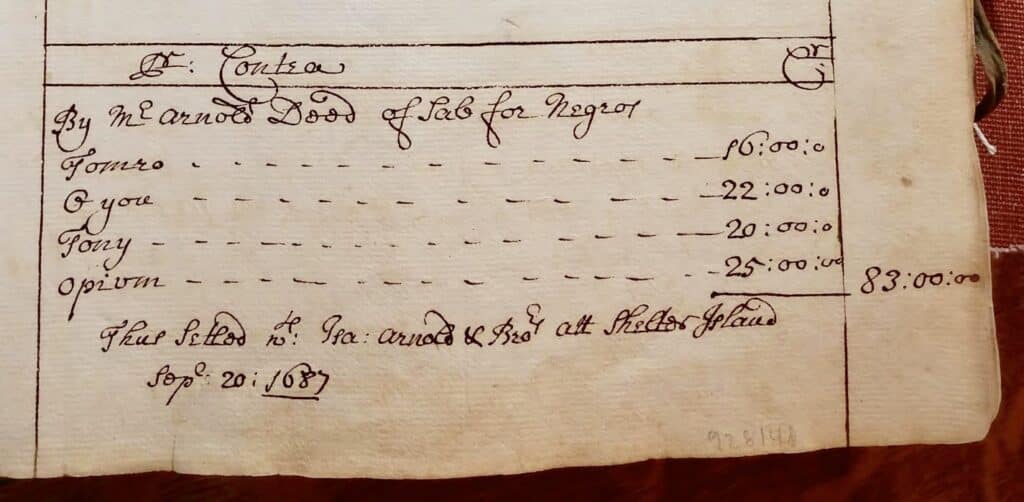
There are thought to be up to 200 graves on the grounds, the final resting place of Manhansett Indians, enslaved Africans, and European indentured servants, who helped to supply food, timber, and materials to the West Indies — including supplies for the Sylvester family sugar plantations in Barbados — as part of the colonial “triangle trade,” in which slaves were bought on the African Gold Coast with New England rum and then traded in the West Indies for sugar or molasses, which was brought back to New England to be manufactured into rum. Last week, at the request of the board of the educational farm, Dr. Mrozowski and a team from N.Y.U. performed ground-penetrating radar surveys to help determine the locations of the gravesites.

The working plantation became a gentleman’s farm in the 18th century. After the Civil War it became the country estate of E.N. Horsford, a scientist said to have revolutionized industrial food production through the introduction of chemical fertilizers. His daughters, meanwhile, revived the colonial gardens, remnants of which can still be seen on the grounds along with the Georgian manor house, 18th and 19th-century outbuildings, and a rare 1810 Dominy windmill. Mrs. Fiske, who died in 2006, restored the gardens, including trees believed to have been brought to America as cuttings in the 17th century.

Music has also played a part at Sylvester Manor, both past and present. Today, the educational farm holds an annual “Plant and Sing” festival in October and sponsors contra dances and concerts at the Shelter Island School. The most recent, a bluegrass concert by Della Mae, a Boston bluegrass band, was a sellout.

Mr. Konesni can often be seen singing and playing a fiddle or banjo himself, as can his wife, Edith Gawler, who performs folk tunes both locally and professionally. The couple will open a show on April 6, along with the Sylvester Manor Worksongers and Cindy Kallet and Grey Larsen, well-known folk musicians. Traditional Irish music, Scandinavian fiddle duets, old-time fiddle and guitar tunes from southern Indiana, and new original music will be performed at the farm for a fee of $15, $5 for students.

The following week, on April 10, an opening reception for the N.Y.U. exhibition will take place from 6 to 9 p.m. at the Elmer Holmes Bobst Library, 70 Washington Square South. Correspondence with Thomas Jefferson is included in the show, as are land deeds signed by Nathaniel Sylvester with Native Americans — among them Wyandanch, sachem of the Montaukett tribe — in the 1660s. The exhibit will also celebrate two books about Sylvester Manor: “The Manor: Three Centuries at a Slave Plantation on Long Island,” by Mac Griswold, and “Slavery before Race: Europeans, Africans, and Indians at Long Island’s Sylvester Manor Plantation, 1651-1884,” by Katherine H. Hayes.

The exhibition is free and open to the public. Reservations for the opening reception are required, and can be made through rsvp.bobst@nyu.edu. Information about guided tours of Sylvester Manor can be found at sylvestermanor.com.

SM Featured in Preservation Magazine

Music, history, farming, and food come together when a 350-year-old estate on Shelter Island opens to the community.

By Nate Schweber | From Preservation Magazine | Spring 2013. Read the full article at preservationnation.org 
To view the PDF “print” version, click here.

On a celebratory early fall day, chef Matty Boudreau, a royal blue apron wrapped around his stocky middle, handed out vegetarian sandwiches at a festival called the Plant & Sing. Hungry folks milled around the farm, a cool Atlantic breeze turning everyone’s cheeks a little pink.

The sound of plucked banjo strings crackled in the air, courtesy of the great instrumentalist Béla Fleck, who sat a fishing pole’s cast away on a makeshift stage. Groups of snackers added satisfied melody lines: Each savory chomp of cucumber, grilled al dente at Boudreau’s food truck, made sounds like cans of soda popping open.

“What’s really neat about this,” says Boudreau, owner of the Vine Street Café on Shelter Island, “is it brings it full circle.”

The vegetables Boudreau served at the Plant & Sing were harvested and eaten within a few hundred yards of each other, and all within shouting distance of the nearly 300-year-old Sylvester Manor home, a Georgian-style house flanked by 20th-century porches wrapped in vines of climbing roses. It is now on its way to becoming a historic landmark, one pulsing with the vibrancy of new life.

Far from being just another old building—fighting entropy, struggling to assert its relevance in a fast and forgetful world—Sylvester Manor has undergone a renaissance because of the very thing for which it was founded: food.

“We’re digging into the past to pave our way to the future,” says Bennett Konesni, a kinetic, 11th-generation descendant of the island’s founder. Konesni started the Plant & Sing fundraiser as a way to open Sylvester Manor and the farm up to the community and celebrate history, food, and culture.

In addition to this annual community event, the farm sustains itself by selling produce to markets and restaurants in and around the perimeter of this 8,000-acre island nestled in a crook of the Atlantic between the North Fork and the South Fork of Long Island. Sylvester Manor has become so integral to the area that some establishments now allow the farm to dictate their menus. Carrie Mitchum, former executive chef at Salt Waterfront Bar + Grill, a restaurant on the island, recalls purchasing some of Sylvester Manor’s autumn gourd crop and then creating a robust and tangy puree of red kuri squash, butternut squash, acorn squash, and pumpkin.

“They adhere to high organic standards,” Mitchum says. “So as their harvest changed, so did our soup.”

These annual vegetables are value added to Sylvester Manor’s perennial crop: history. The story of European settlement on Shelter Island goes back to the mid-1600s, and food is the thread that runs root to flower: from the manor’s inception as an industrial food supplier; through its years as a summer home for Eben Norton Horsford, a pioneering food chemist; to today, when Horsford’s great-great-great-great-grandson Konesni created a life, and the Plant & Sing, here.

“Members of the same family have lived here since 1652,” said Maura Doyle, Sylvester Manor’s coordinator for interpretation and preservation. “It’s very Jane Austen, something so improbably feudal.”

There is also a shadow history to Sylvester Manor, the oldest, most intact plantation surviving in the Northeast. For nearly two centuries the fruits of this land were cultivated by people who were enslaved, men and women owned as outright as its livestock. At one time, Shelter Island had one of the largest enslaved populations in the region.

How can a place reconcile the shame of this nation’s original sin with a joyous and idealistic rebirth? By being transparent, says Konesni, who carries in his blood the DNA of the English sugar merchant and slave owner who founded the island.

“To honor and explore this history in new ways,” he says, “you acknowledge the worst.”

Of all the artwork inside Sylvester Manor, including elegant ships painted on Dutch Delft tiles and portraits of bygone residents, it’s an amateur’s etching that is the most gripping. Through the dining room, up a creaking staircase and into the attic—the place where stories and secrets are accumulated—there are sailboats etched into a wooden wall. They were carved by a Montaukett American Indian boy named Isaac Pharoah, who was indentured when he was 5 years old, and reportedly buried in a cemetery reserved for the manor’s enslaved.

“It’s very powerful,” says Doyle, who gives tours of the home. “It’s haunting.”

In 1651, a man named Nathaniel Sylvester came to Shelter Island and purchased it from Englishman Stephen Goodyear for 1,600 pounds of sugar. Then, in 1652, after a court dispute, which negated Goodyear’s right to sell the land, Sylvester purchased the island again, this time from the Manhansett People, whose indigenous ancestors had probably lived there for at least 14,000 years, archaeological evidence shows. Sylvester had three business partners, one of them his brother, and they needed food—not just for themselves, but for the people they enslaved.

Sylvester’s partners ran sugar plantations in Barbados, and by establishing a farm on Shelter Island they would be able to grow food for their labor force. By 1653 enslaved labor came to Shelter Island.

Eventually the business partnership dissolved, and Sylvester came to own Shelter Island outright. When he died, he enslaved 20 people—one of the largest enslaved populations in mid-1600s New England.

Inside the manor house, decorative elements such as this wallpaper from the 1880s have been well preserved.

“The wealth of the manor was based on slave labor, and I say that because if you have somebody else who can farm and do the work that you would do, that’s the basis of wealth,” says landscape historian Mac Griswold, author of The Manor: Three Centuries at a Slave Plantation on Long Island, which will be published in June.

Not all was oppressive in early Shelter Island history. It’s worth noting that Sylvester showed uncommon religious tolerance, and Quaker George Fox, founder of the Society of Friends, preached here twice. The island was also a temporary sanctuary for Quaker Mary Dyer, who in 1660 in Boston was later hanged for her beliefs.

In 1666 King Charles II of England declared Sylvester’s covenant house an official manor. But it wasn’t until about 50 years after Sylvester’s death in 1680 that one of his heirs built, as a country estate atop the original home site, Long Island’s oldest Georgian-style home, which still stands today.

The front of the ochre-painted Sylvester Manor, with its symmetric dormers, six-over-six double-hung windows, and black painted shutters was built between 1735 and 1740. In early 1908, white pillars were added around the porch and the Colonial Revival-style addition was tacked on to the rear of the home.

The 18th-century part of the house features four square rooms furnished with sofas, tables, paintings, and desks. In one room, wallpaper depicting tropical palms dates to 1888 yet retains its vivid color. Across the entryway, in the East or Morning Parlor, some of the walls’ cream-colored paint from the late 1800s has chipped away, showing underneath the original cool Prussian blue from the mid 1700s. The fireplaces in both rooms are edged with Dutch Delft tiles set in 1908.

Through the years, Sylvester Manor—which once spanned the entire island—sold off most of its acreage. Ultimately the town of Shelter Island was incorporated, and today it boasts a year-round population of about 2,500 with a seasonal population almost four times that number.

Sylvester Manor freed its last enslaved person in 1821, a man named London, almost 170 years after the first enslaved men, women, and children were brought to the island and six years before slavery was abolished in New York State. It ended a shameful chapter in the manor’s history, but it also heralded the land’s shift away from food production.

In the mid 1800s, a food chemist named Eben Norton Horsford and his wife, Phebe, a lineal descendant of Nathaniel Sylvester, turned the estate into their summer home. Horsford, a Harvard University professor, perfected the recipe for baking powder by adding calcium biphosphate. He co-founded Rumford Chemical Works, an offshoot of which still produces Rumford Baking Powder. While Horsford fine-tuned his recipes in a laboratory, Sylvester Manor’s two-acre garden was adapted into the Colonial Revival style, filling it with plants such as boxwood, which is believed to have been introduced to North America by Nathaniel Sylvester himself.

Horsford’s daughter Cornelia used her inherited wealth to hire Beaux Arts architect Henry Bacon to build the Colonial Revival addition onto the original home in 1908. Bacon went on to design the Lincoln Memorial in Washington, D.C. One of his flourishes at Sylvester Manor was a musical alcove that would enhance the acoustics of stringed instruments.

By the middle of the 20th century, Sylvester Manor passed into the hands of a man named Andrew Fiske, a 9th-generation descendant of Nathaniel Sylvester. By then, the estate was whittled down to just 260 acres.

In the 1950s, a team of tree-planters dug up something amazing. They found, about 100 feet from the front door, a cannon dating to 1670 that was buried in the ground, probably to keep it out of the hands of the Dutch. The find hinted at untold treasures on the property.

Fiske died in 1992. His widow, Alice Fiske, a kind, eccentric, elderly woman who was fond of Italian hats and white cotton gloves, endowed a research center at the University of Massachusetts Boston to send down teams of archaeologists. It was a perfect match: a curious patron and hungry students excited by the good fortune of being granted access to a rare Northeastern estate that hadn’t been covered by layers of development.

The windmill, built by Nathaniel Dominy in Southhold in 1810, was barged to Shelter Island in 1840, moved from the center of town to Sylvester Manor in 1926, and restored in 1952 as part of ongoing preservation work. The inner workings included two stones, one for wheat, the other for corn.

In 2001, one of the diggers was Bennett Konesni, Alice Fiske’s grandnephew and a descendant of Nathaniel Sylvester. Born in Asheville, N.C., Konesni was raised in rural Maine, and learned organic farming at Quail Hill Farm in Amagansett, N.Y. In 2005 he received a fellowship to travel the world and learn folk songs from countries including Switzerland, Mongolia, the Netherlands, Tanzania, and Ghana.When Alice Fiske died in 2006, Sylvester Manor passed to her nephew Eben Fiske Ostby, a renowned animator and one of the creative founders at Pixar, the pioneering computer-generated-imagery company.

Ostby had a vision to preserve the manor’s land, and his nephew Konesni had a vision to make it a farm again. With his uncle’s blessing, Konesni moved to the island and began farming using organic techniques. Soon, with volunteers, he had planted squash, peppers, beans, watermelons, pumpkins, turnips, sweet potatoes, spinach, and tomatoes.

“I love farming and I love being on the land,” Konesni says, and under his leadership, Sylvester Manor has begun to cultivate the next generation of American farmers. A handful of interns live upstairs in the historic house, spending their days working the soil outside. These young agrarians have come from all over the world, traveling through Gatsby country and hopping aboard the ferryboat at land’s end for the ride to Shelter Island.

“This place brings in so many special people who want to be part of its history,” says Cassie Woolhiser, 23, who hails from Missoula, Mont., and describes the experience of being a Sylvester Manor farmer as like “living in a museum.”

Where once there was forced labor, today it is largely volunteer.

Ostby and the board of directors that oversees Sylvester Manor have worked to protect the farmland by legal means, such as securing conservation easements through a local land trust. Konesni, meanwhile, threw his boundless energy into attending community meetings and bringing samples of his vegetables to area restaurants. There he won over disciples like local French chef Martine Abitbol.

“I cannot cook it if it’s not fresh from the farm,” Abitbol says.

Drawing from his year abroad, Konesni has made music a part of life at the manor. He organizes traditional and bluegrass music concerts in the Bacon-designed living room, and has taught interns to sing Ghanaian folk songs in the vegetable patches.

Every October, food and music mix at Konesni’s pièce de résistance, the Plant & Sing festival. The estate’s gates swing open, musicians perform on a harbor-side stage, poets read on rosy porches, historians give tours, and local chefs cook produce picked from the fields. Far below the harvest moon at night, farmers and friends do-sido on the lawn to the sound of a live string band.

“It’s an honor to explore Sylvester Manor in new ways,” says Konesni, dressed in blue jeans and red flannel, as he lays down his guitar between songs to take a break.

“There’s such a rich tapestry of food history here, it makes sense that we add onto it in our own way.” Suddenly, he stops. He cocks his head to make out the next song. Then he apologizes.

“I’ve got to play this tune,” he says, and he leaps back onstage to sing.

Online Exclusive: [Book Review] “Farmhouse Revival” and the Rural Aesthetic

Nate Schweber is a freelance journalist from Missoula, Mont., now living in Brooklyn. His work has appeared in The New York Times, Rolling Stone, Time, Budget Travel, and The Village Voice. He is lead vocalist for the band the New Heathens.

For more photos, stories, and tips, subscribe to the print edition of Preservation magazine.

The Architectural Component of the Historic Structures Report is Complete!

smA key step in preserving the history of Sylvester Manor was accomplished this week with the completion of the Architectural Component of the Historic Structures Report. Prepared by Robert Hefner, the East Hampton Village Historic Preservation Consultant, this document is a formal analysis of a building: its unique history, its place in architectural history, and complete description of the building, its architecture and current state.

According to Bob Hefner, “Sylvester Manor was the first Georgian house on eastern Long Island and is important in the context of the early Georgian houses of New England”  Its hipped roof, with chimneys at either end of the ridge, connect Brinley Sylvester’s house directly to Newport, where he had strong family ties. The report is a detailed analysis of this house in the context of other Georgian houses, and then goes on to describe the major renovations that were subsequently undertaken. Having this report gives us a deeper understanding of the unique qualities of this structure, and will assist us in preserving it.

See for yourself!

Click here to read the Architectural Component of the HSR
Click here to see the accompanying illustrations

In the SI Reporter: Archaeologists at Sylvester Manor

Article from the Shelter Island Reporter written by  , on 03/19/2013 8:26 AM

Early Monday morning in the bare, bitterly cold woods of Sylvester Manor, two men were up on a hill searching for the past.

Stephen Mrozowski stared at the ground as John Steinberg dragged a squat metal box with one wheel attached over the thick leaf cover, looking at a monitor hung from his neck. They were on a wide patch of ground under white pine trees within a slatted wood fence that looked in places like an old comb missing some teeth.

“Oh, yeah,”  said Dr. Steinberg, an archaeologist. “Yeah, Steve, look at this.”

Dr. Mrozowski, an anthropologist/archaeologist from the University of Massachusetts, looked at the monitor, which was undulating with waves of lines. “Yes,” he said.

The rig Dr. Steinberg was attached to is a machine called ground-penetrating radar, or GPR, technology akin to radar or sonar. Dr. Mrozowski explained that electronic beams were sent into the ground to see if anything bounces back.

The two scientists, part of a team from the Andrew Fiske Memorial Center for Archaeological Research in Boston, were out in the Island woods surveying what is from all reports a burial ground holding graves from as long ago as the 17th century.

Anecdotal evidence says there could be as many as 300 souls interred on the fenced hillside not far from North Ferry Road. The story goes that African slaves, free black men and women and Manhansett Indians who worked at or were associated with the Manor are buried here.

Dr. Mrozowski pointed out a massive stone at the foot of the hill. Words inscribed on the stone 125 years ago are now withered by time and just legible: “Burial Ground of the Colored People of Sylvester Manor.”

The white pines standing like sentinels on the hill were planted around 1900 in the belief the sweet-smelling needles would keep the air clean and disease-free around the burial site.

The team from Boston was careful to say that something was down below, but it was too early to tell exactly what. The positive response from Dr. Steinberg’s portable GPR equipment could be picking up large rocks and not graves and human remains, Dr. Mrozowski said.

John Steinberg and Dr. Steve Mrozowski run the ground penetrating radar over a section of the cemetery.  They will have more answers in the coming week. At this point they are excited about the results of the readings. They will be working until Wednesday as long as the weather cooperates.

PHOTO BY JENNIFER RUYS | John Steinberg and Dr. Steve Mrozowski run the ground penetrating radar over a section of the cemetery. They will have more answers in the coming week. At this point they are excited about the results of the readings. They will be working until Wednesday as long as the weather cooperates.

Using GPR was a non-invasive — as opposed to digging — method of finding if there are graves and then mapping them, Dr. Dr. Mrozowski said.

He’s been all over the world searching for ancient cultures, revealing tangible remains that bring us closer to the people who lived and died long ago.

He’s been on Shelter Island before. Between 1998 and 2005, as  director of the archaeological team, Dr. Mrozowski spent summers excavating Sylvester Manor’s grounds, unearthing a cultural mix of Native American, African, Dutch and English lives. In scholarly journals he’s noted that the archaeological record at Sylvester Manor is a natural laboratory to study the interactions of the various cultures that were here in the 17th and 18th centuries.

As the morning wore on it got colder, but the arrival of UMass grad students brought some warmth to the site with their chatter and energy as they raked leaves down to the bare earth.

Later in the day, a dozen Shelter Island School students came by on a field trip for their course, “History of Shelter Island,” led by teacher Peter Miedema.

But earlier, with just the archaeologists  patiently working the GPR and silently moving across the area, there was an air of mediation as well as scientific research along with a natural instinct of respect that is felt in cemeteries.

But for a cemetery, there was something missing. Wouldn’t head stones be marking the graves?

Dr. Mrozowski explained that for the class of people who would have been buried at Sylvester Manor three hundred years ago, the only markings for their lives and deaths would have been simple rocks.

He began pointing them out, colored brown and gold, partially covered with leaves, dotting the hillside.

AMBROSE CLANCY PHOTO | Stephen Mrozowski, an anthropologist/archaeologist from the University of Massachusetts, at Sylvester Manor Monday morning.

AMBROSE CLANCY PHOTO | Stephen Mrozowski, an anthropologist/archaeologist from the University of Massachusetts, at Sylvester Manor Monday morning.

NYU Spring Lecture Series to Highlight Sylvester Manor

On Wednesday, February 6th at 12:30pm Dr. Michael LaCombe, Associate Professor at Adelphi University and author of Political Gastronomy: Food and Authority in the English Atlantic World, will take part in a lecture being hosted at New York University’s  Fales Library.
Michael LaCombe Sylvester Manor Talk

The lecture is part of an ongoing series being hosted at NYU by the “Sylvester Manor Working Group,” which was formed to inventory and preserve 10,000 historic records donated by Manor owner Eben Ostby to the Fales archive.

Also part of the project, is an exhibit at the library titled “Sylvester Manor: Food and Power on a Northern Plantation,” which will open on April 10th.

Check back for more information on programming related to this partnership.

Film Screening: The Sugar Connection

sugar connection updated-36

The documentary film The Sugar Connection: Holland, Barbados, Shelter Island shows Long Island’s participation in the 17th century global trade by the Sylvester family of Shelter Island.  Directed by Suffolk County Archaeological Association Executive Director Dr. Gaynell Stone, the film chronicles seven years of archaeological excavations at Sylvester Manor led by Dr. Stephen Mrozowski of UMass Boston, whose team unearthed over 500,000 artifacts, complimenting the thousands of family papers and primary documents archived by the family.

Monday, February 11, 2013 1pm at the Farmingville Town Hall at One Independence Hill, Farmingville, NY.  This screening is presented through a collaboration of the Town of Brookhaven and the Suffolk County Archaeological Association.  The program is free of charge, but please RSVP to brussell@brookhaven.org or at 631.451.8038.

Friday, March 1, 2013 7pm at the Shelter Island Public Library at 37 North Ferry Road, Shelter Island, NY. This screening is presented through a collaboration of Sylvester Manor Educational Farm, The Shelter Island Public Library, and The Shelter Island Historical Society.

A tour for Scholars at the Manor

On Monday twelve scholars from New York University and nearby institutions toured Sylvester Manor and grounds to see first hand the site that generated the NYU Fales Library archive. Mac Griswold led the tour, and for many it was their first visit to the property.  They represented a cross section of disciplines, including 17th, 18th, and 19th century Atlantic history, architecture, agriculture and native whaling.  They are very appreciative of the archival gift from Eben Ostby and were pleased to visit the property.  They understand the importance of this gift in ways that non-scholars cannot appreciate.

Participants were served a lovely Sylvester Manor Squash Soup and local greens, and participated in work songs led by Bennett, Edith and Steve. Maura organized the event.

The tour comes in advance of the NYU Exhibition “Sylvester Manor: Food and Power on a Northern Plantation” which opens at the NYU Fales Library on April 10, 2013 (Mark your calendars!). It’s based on the extensive family papers as well has historic objects and archaeological materials excavated at the site.  According to the curator Jennifer Anderson, “Together these unique documents and artifacts offer a fresh perspective on this important, but little-known historic site, reminding us that our urban lives are still enriched through a deeper engagement with the land and its human heritage.”

Sylvester Manor documentary screening

Hello Sylvester Manor supporters,

The Southampton Historical Museum and Rogers Memorial Library are hosting a showing of the film “The Sugar Connection,” a unique documentary on the history of the Sylvester family and the manor.  The film will be shown this Thursday, September 27, at 3 pm at the Southampton Library.  The manor’s Bennett Konesni, a Sylvester family descendant, will be on hand to answer questions.

It is an enlightening film that highlights the role of Sylvester Manor in the global economy.  Reservations are appreciated. Register at www.myrml.org or call 631.283.0774 x 523

Harvard Gazette writes about 11th Lord of the Manor Eben Horsford

Check out this cool article in the Harvard Gazette about Eben Norton Horsford, who owned the Manor in the mid-1800s. As the father of American food chemistry and inventor of baking powder he is an important link in the history of food. And this photo has me wondering- was he an even more important link in the history of extreme muttonchop sideburns? He was an eccentric guy and a fascinating chapter in the Manor’s history. -Bennett

Bubble, bubble — without toil or trouble | Harvard Gazette.

Eben Norton Horsford